
Technological developments in the treatment of scars that may occur due to accidents, burns, previous surgical procedures or traumas that the person has done to their own body are increasing our treatment options and success rates. How much scar will remain depends on the type of incision, the type of cutting tool, the type of accompanying traumas, the infections that occur in that area afterwards
Scars (scars) create aesthetic and psychological problems in human life.
There is always a demand for their removal because they usually remind us of an unwanted trauma and also because of the aesthetic problem they create.
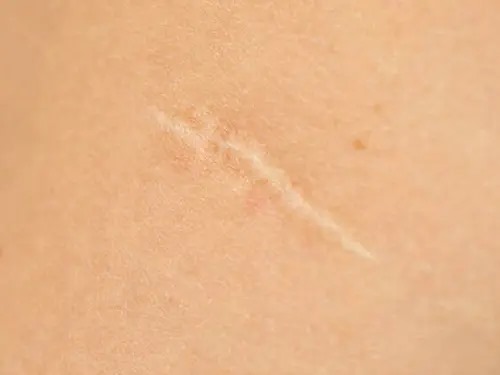
Technological developments in the treatment of scars that may occur due to accidents, burns, previous surgical procedures or traumas that the person has done to their own body are increasing our treatment options and success rates. How much scar will remain depends on the type of incision, the type of cutting tool, the type of accompanying traumas, the infections that occur in that area afterwards, the first intervention and its effectiveness, the success of the treatment of the person who performs the incision repair and most importantly the response of the person’s tissues. What falls to us Plastic Surgeons is to make a formed scar as visible as possible.
There are different treatment options ranging from removing the scarred healing tissue in the incision area with the method we call scarrevision (scar treatment) and re-sewing it appropriately and with appropriate suture materials to laser treatments.
Our aim is to minimize scars and, if possible, hide them in body lines and curves. However, it should be known that a scar never heals with zero error. Every cut leaves a scar, more or less. Our duty is to ensure that there are “few scars”.
What are the most common types of scars?
However, the scars that remain after traumas requiring emergency surgery, accidents, stabbings, glass and razor (face scars) cuts, long-lasting wounds and surgical operations are the most common situations we encounter.
When can scar correction be performed in cases of trauma, incision and surgery?
While the timing varies depending on the condition of the patient and the wound, correction operations are usually performed for 6 months to 1 year. During this process, the wound matures and takes its final form.
What changes may occur in wounds or incision scars over time?
Although there are differences in the reaction of the person’s tissue to the wound, the color of the stitched area, which may appear red and slightly swollen at first, fades and the swelling decreases over time. In some patients, a healing tissue is seen outside the stitch area over time, which is called a hypertrophic scar, and in more serious cases, a keloid.
Do incision scars heal the same way all over the body? In which areas are there fewer scars?
In areas where there is a lot of tension, such as the arms and legs, it is expected that there will be more scars in areas where tension is applied, such as the surgery areas. However, there are some areas where more scars will naturally remain. In some body areas such as the front of the chest (sternum), shoulder, back, and earlobe, the risk of hypertrophic scars and raised scars called keloids is high. In the eyelid and genital area, there will be fewer scars.
What is the best time to start scar treatment?
This decision will be made at the end of the examination by a specialist physician. For this reason, it is necessary to apply as early as possible and create a plan and schedule for early and late precautions to be taken.
How can a wound or incision be treated in a way that leaves the least scar?
The first intervention of the wound or incision is very important. Stitching without leaving a scar is the request of every patient. First of all, the wound should be cleaned of foreign objects and its edges should be refreshed if necessary. Foreign bodies in the incision area should be removed mechanically and with plenty of serum physiological washes. Tetanus prophylaxis and, if necessary, prophylactic antibiotic treatment are applied. The tissue layers in the incision area should be stitched (sutured) in the appropriate plan and with appropriate suture materials.
It is essential that post-treatment checks are performed regularly by the treating physician. The stitches should be removed at the most appropriate time. Because too much stitching means too much inflammation (foreign body reaction) and too much scarring. Early removal carries the risk of opening and too much scarring. Another important factor in preventing stitch scarring is protection from the sun. The incision area should be physically protected from the sun as much as possible for about 1-2 years and sun protection factor creams should be used.
What are the important treatment steps in emergency treated incisions?
First of all, if possible, the correct first intervention to be performed by a plastic surgeon,
Regular dressing and follow-ups,
Protecting the wound area from physical, chemical and solar (sun) effects for at least 12 months,
Balanced diet, avoiding smoking,
Silicone-containing creams, gels and tapes can be used when necessary,
Laser treatments are also among the instruments we use for wound and incision scars.
How are razor (faça), knife and incision scars on the arm treated?
In appropriate incision scars, they can be removed in a single session, and in thick incision scars, they can be removed gradually (in several sessions) and turned into more acceptable and less noticeable surgical scars. Follow-ups can be made with silicone-containing creams and gels. In some patients, we start laser treatment instead of surgery.
What is there in burn scar treatment?
First aid is very important in burns. However, unfortunately, scar formation cannot be prevented in deep burns. While other wound and incision scar treatment principles are valid for suitable burns, for large and deep burns, we use many techniques such as tissue expanders, scar revisions, contracture openings, local and free flap applications.
Can lasers completely remove scars?
Laser is one of our most important technological instruments in scar treatment. Laser treatments usually continue for more than one session. In laser scar treatments, patient expectations should be kept at realistic levels and the process should be explained to the patient in detail. Sun protection is one of the main warnings after laser treatments. The number and interval of sessions in laser treatments are determined by the physician.
